
The Learning Feedback Loop: Turning Manufacturing Experience into Reusable Knowledge
The Learning Feedback Loop: Turning Manufacturing Experience into Reusable Knowledge
Modern manufacture of bulky parts is highly specialized to the specific piece and presents difficulties for automation in the assessment of process health and downstream quality during production. Yet, early identification of faults, quality issues, or unnecessary operations is crucial to avoid expensive rework and is currently dependent on highly experienced operators familiar with the process manually and subjectively assessing process health. The varying cutting machinery, dimensions and context for such operations complicate the effort of generating models that generalize to capture deviations across parts and machines.
The REED project addresses this challenge through the Learning Feedback Loop (LFL), a system designed to combine machine data, process context, and human expertise into a continuous cycle of learning and improvement.
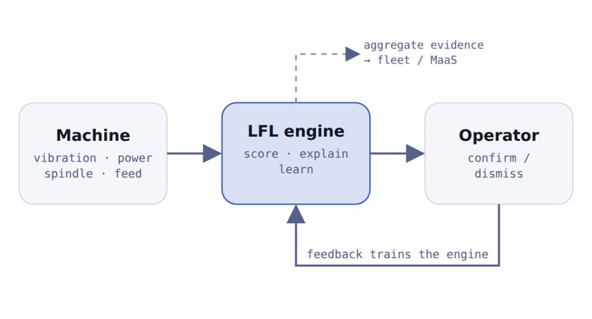
From machine data to meaningful events
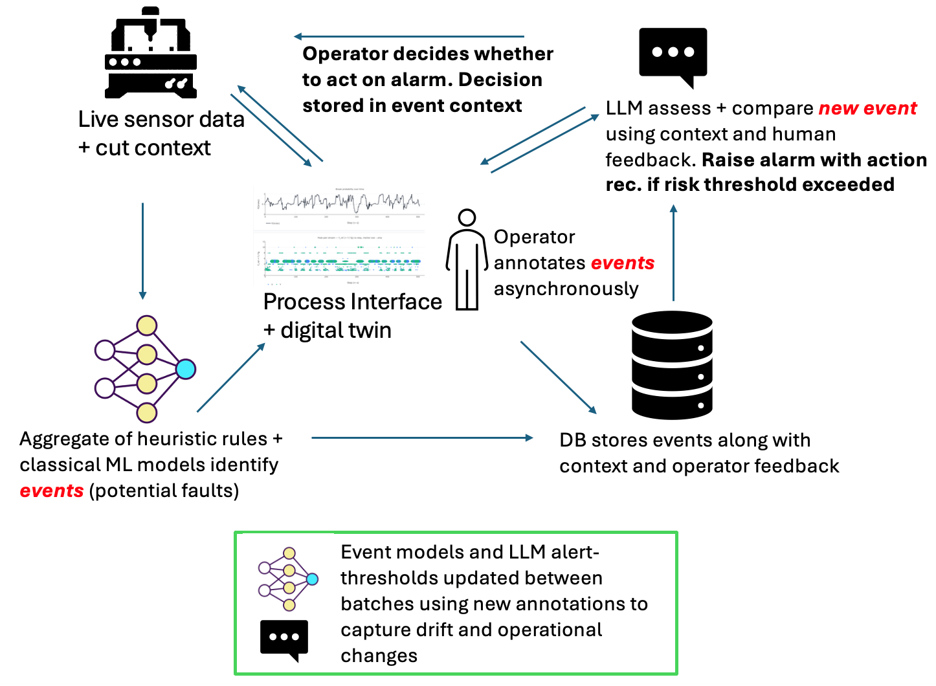
The process starts with streaming data collected from manufacturing equipment. Every second, three scorers continuously monitor for anomalies: a simple heuristic for relative amplitudes of vibration at different frequencies, an unsupervised model looking for outliers in time series data, and a convolutional neural net integrating cutting context trained to detect tool break. Output from the three scorers is fused to produce a single indicator of whether an anomaly is predicted at a given point in time. In such case, the system creates an event that summarizes what happened, based on the streaming data and output of the scorers, and why it may be relevant.
Each event is associated with machine, tool, operation, material, and production order involved, and can be interpreted alongside the context produced by a digital twin.
Interpreting Events in the Context of Memory
Events are stored in a memory database together with their context and supporting evidence. Over time, this creates an operational memory with an associated knowledge graph of past manufacturing situations. When a new event occurs, a prompt is generated for an LLM summarizing similar previous events, the cutting context, and previous operator feedback. If an event’s risk scores exceed a threshold, the LLM uses this information to generate an alert for operators, accompanied by an explanation and action recommendations based on machine documentation and past procedures.
Interactions with the LLM are made with appropriate guardrails wherein the model may only access the local memory database, machining context, and machine documentation relevant to the current batch. Recommendation outputs are forced to conform to a human-readable format. Hallucinations and over-confidence are mitigated by blocking direct machine-control instructions and checking that numbers and tools quoted by the LLM correspond to what is present in the evidence pack available to the model.
Learning from operators
A key feature of the LFL is that operators remain at the center of the process. When an alert is presented, users can confirm that it is important, dismiss it as normal behavior, or add comments and annotations. This feedback is stored alongside the event and becomes part of the learning process which an LLM uses to compare events. If a new event is classified as being indicative of an imminent fault, human operators can also manually compare with the context, comments and outcome on past, similar events to determine the best course of action. Furthermore, if a fault occurs without an alert having been generated for the operator, the operator may manually create the associated event with appropriate context and notes.
At the end of a production batch or unit; anomalies, feedback, and trend indicators from the most recent cycle are used by the LLM to generate reconfiguration recommendations for the next batch.
Additionally, scheduled or operator-initiated updates to the scoring models and alert thresholds using recent anomaly data make sure the feedback loop stays accurate.
The process is summarized in the figure below.
Continuous improvement through feedback
The result is a practical learning cycle. Machine-monitoring systems detect events, historical knowledge provides context, operators contribute expertise, and the system uses this accumulated experience to improve future assessments.
Rather than replacing human expertise, the LFL helps preserve it, making valuable operational knowledge available across shifts, machines, and future production runs. This supports more informed decisions, faster problem identification, and a more resilient manufacturing environment.
Authors: Simeon Tverdal, Sondre Sigstad Wikberg, Phu Nguyen (SINTEF)