
Description:
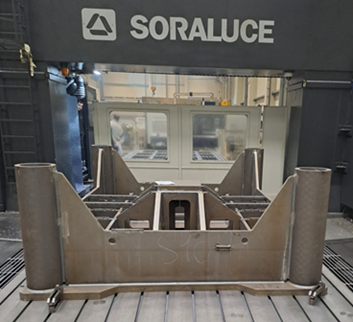
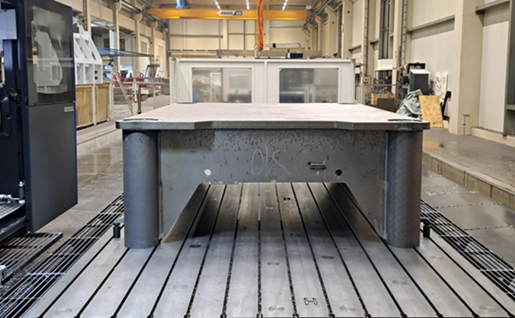
The second pilot project involves a component used in a deburring machine for automotive applications. The system is subject to extremely high precision requirements and achieves dimensional accuracies of up to ±0.01 mm with overall machine dimensions of 4000 × 3000 mm. This tight tolerance range is essential to ensure the required process stability and reliability in subsequent series production.
The machine operates with pressing forces in the range of several thousand bar. As a result of these high mechanical loads, the component is subjected to significant static and dynamic forces. For this reason, strict adherence to the specified dimensional and geometrical accuracies throughout all manufacturing and machining stages is of critical importance to the success of the pilot project.
The metal forming machinery sector focuses on equipment for the controlled plastic deformation of metals using mechanical, thermal, and hydraulic forces. A critical downstream process is deburring, as forming and cutting operations inevitably generate burrs that affect dimensional accuracy, functionality, and surface quality. Consequently, advanced deburring technologies are an essential component of automated production lines, particularly in high-volume industries such as automotive manufacturing, household appliances, and heavy industrial equipment. The key challenge in this type of machining, particularly with regard to the component height, is to reliably achieve the specified surface quality while completely avoiding vibrations, oscillations, or undesired patterns in the resulting milling surface. Even minor process instabilities can lead to visible surface defects or deviations from the defined quality requirements.
For this reason, continuous and close monitoring of the machine throughout the entire machining process is essential in order to detect potential issues at an early stage and eliminate them immediately. In this context, tool breakage detection is playing an increasingly critical role in ensuring process reliability. Any error occurring during the machining process typically results in significant rework of the component and must therefore be consistently avoided.
Picture:
Lead partner: Maschinenfabrik Wüstwillenroth GmbH
Other partners involved: Ideko, Dr-Matzat, Soraluce, Ibermatica, Netcompany-Intrasoft, Sintef, University of Patras, TU Darmstdat, Moduleworks, Smarttech, 2.-0 LCA Consultants
Metal Forming Machinery Sector - MASCHINENFABRIK WUSTWILLENROTH GMBH
Business hour
Our support available to help you 24 hours a day, seven days a week.
Monday-Friday: 9am to 5pm
Saturday: 10am to 2pm
Sunday: Closed
Monday-Friday: 9am to 5pm
Saturday: 10am to 2pm
Sunday: Closed