
The integration revolution: How REED's platform architecture is unifying European Manufacturing Services
In Europe's fragmented manufacturing landscape, specialized digital services operate in isolation, forcing manufacturers to navigate incompatible systems and costly custom integrations. The REED Manufacturing as a Service (MaaS) platform is establishing the integration foundation to transform this reality, creating the first comprehensive ecosystem that unifies manufacturing services for bulky parts production.
Traditional manufacturing environments compel companies to work with disconnected systems—digital twin services from one provider cannot communicate with environmental monitoring tools from another, while production scheduling operates independently from real-time process tracking. This fragmentation prevents manufacturers from leveraging the full power of available digital manufacturing capabilities and limits their competitive potential.
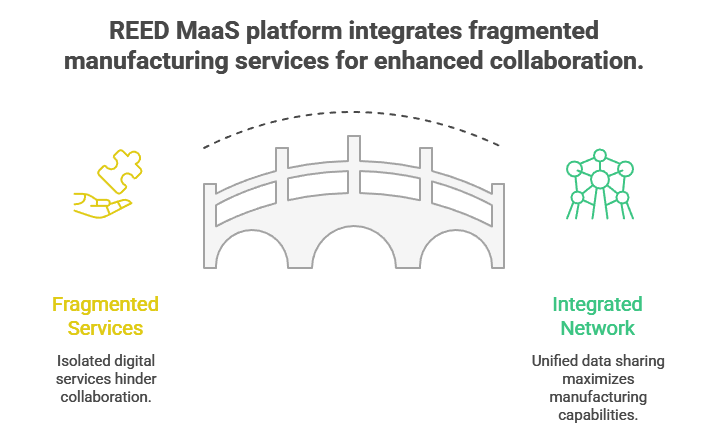
The REED platform addresses this challenge by creating a unified integration layer that connects diverse manufacturing services into a cohesive ecosystem. Built on European digital standards including IDSA and GAIA-X principles, the platform establishes secure connectivity protocols that enable seamless collaboration between previously isolated capabilities while maintaining data sovereignty for each participant.
At its core, the platform serves as the central backbone that connects all manufacturing services developed by REED partners. Advanced cutting tool optimization systems, environmental footprint simulation tools, process tracking solutions, and digital twin technologies now work together through standardized interfaces. This unified approach transforms fragmented capabilities into an integrated manufacturing intelligence network.
The platform's service integration architecture enables automatic coordination between different manufacturing capabilities. When processing manufacturing requirements, environmental assessment tools seamlessly share data with production scheduling systems, while quality monitoring feeds directly into process optimization algorithms. This integration eliminates the manual coordination overhead that traditionally plagued multi-vendor manufacturing environments.
Real-time data sharing across the integrated ecosystem ensures that all manufacturing services operate with synchronized information. Process simulation results automatically inform environmental impact calculations, while production monitoring data updates digital twin models in real-time. This unified data flow creates manufacturing networks that respond as a single, intelligent system rather than isolated components.
The platform specifically addresses the integration challenges faced by small and medium enterprises. By providing standardized connection points for advanced manufacturing services, SMEs can now access integrated combinations of digital twins, environmental assessment tools, and AI-powered optimization that were previously available only through expensive custom integration projects.
Digital Product Passport integration exemplifies the platform's unifying approach. Production data from multiple manufacturing services—machine performance metrics, environmental measurements, and quality verification results—automatically combines into comprehensive product documentation. This seamless integration across different service providers creates capabilities that individual systems cannot achieve alone.
The Manufacturing Data Space implementation ensures that this service integration maintains European values of data sovereignty and security. Manufacturing partners can share necessary production information while retaining complete control over their proprietary data, enabling unprecedented collaboration without compromising competitive advantages.
Through systematic service integration and unified data sharing, the REED platform establishes the foundation for collaborative manufacturing networks that leverage the full spectrum of available digital capabilities. This integration revolution positions European manufacturing to compete effectively by maximizing the value of specialized services through seamless collaboration rather than isolated operation.
Authors: Panagiotis Kourempanas, Christos Kiokakis, Raimund Bröchler (Netcompany- INTRA)