
Dynamic Integration of Product Carbon Footprints into the Digital Product Passport
In REED, the Product Carbon Footprint (PCF) is intended to become part of the product’s Digital Product Passport (DPP) in a way that is interoperable, traceable, and updateable, rather than ending up as a static number in a report. Together with the project partners 2.-0 LCA and i3B - Instituto Ibermática de Innovación, the Technical University of Darmstadt (TU Darmstadt) is designing a framework to automatically integrate the PCF in the DPP.
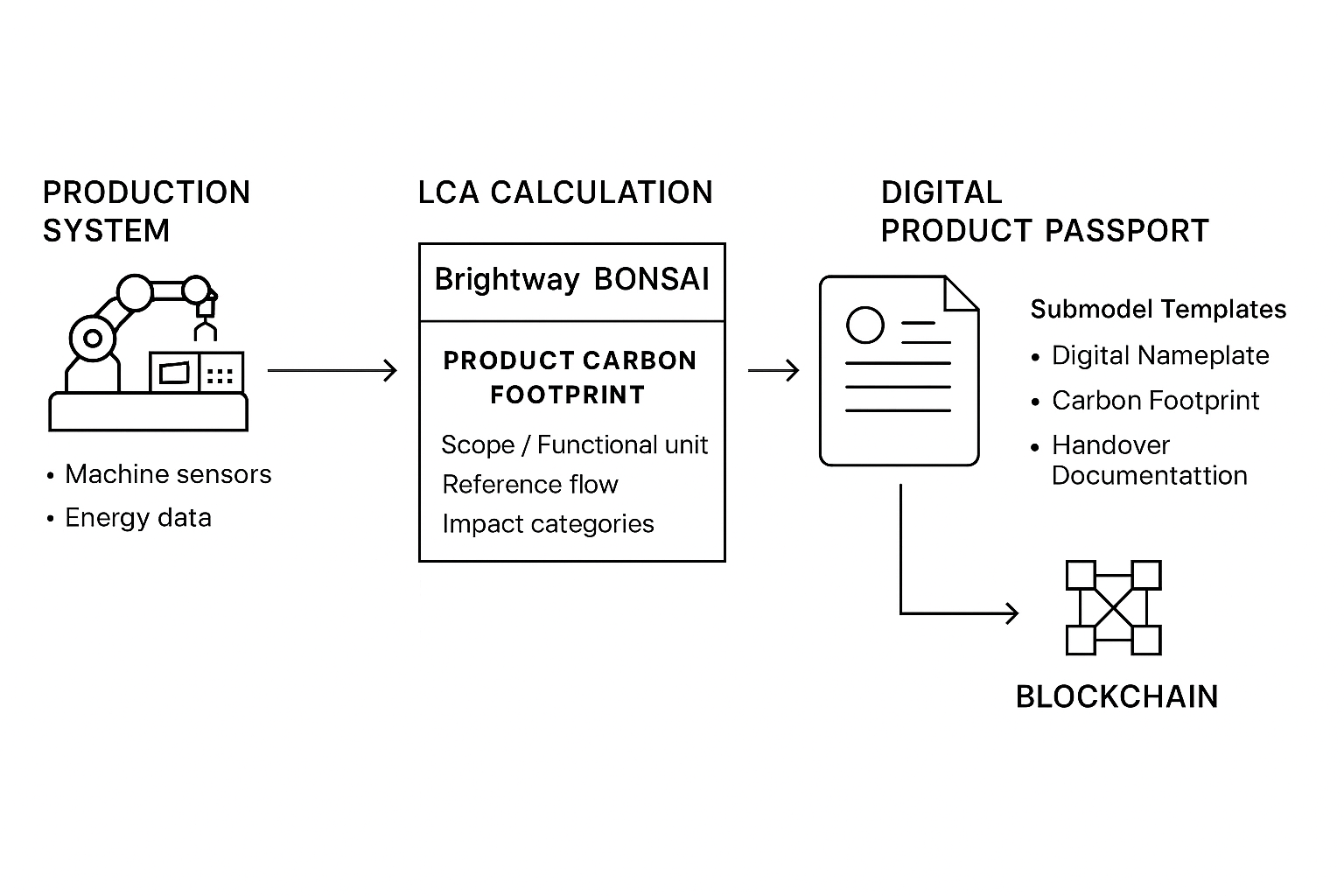
The key idea is to treat the PCF as a structured dataset that can be linked unambiguously to a specific product and exchanged across organizations using the DPP. A practical technical pathway is to implement the DPP using the Asset Administration Shell (AAS). The AAS is an internationally standardised framework for the digital description and provision of information on industrial assets, standardized by the Industrial Digital Twin Association (IDTA). The AAS provides a clear framework and semantics for product data that different systems can interpret consistently. The IDTA offers standardized AAS Submodel Templates for realizing the DPP. For the implementation of the DPP in the REED project we use the AAS Submodel Templates Digital Nameplate, Carbon Footprint and Handover Documentation.
For the calculation of the PCF, 2.-0 LCA uses a life cycle assessment (LCA)-based calculation workflow using the calculation software Brightway with background databases such as the life-cycle inventory database BONSAI. BONSAI contains relevant information for a sustainability assessment like the calculation of the PCF, including environmental impacts in CO₂ equivalents (CO₂e). To assess the PCF we use manufacturing information and sensor-derived energy data. This enables a more dynamic footprint that reflects real production conditions.
Every product is linked to its individual DPP instance. The DPP does not only include a PCF value but also contextual metadata. Using this metadata, we can easily interpret the PCF and use it for further analysis and optimization. Metadata can be information such as scope or system boundary, functional unit or reference flow, impact categories or a time reference. Without this context, the same PCF value can be misleading or incomparable across suppliers and production sites.
To ensure the integrity and trustworthiness of the DPP, I3B integrates blockchain technology as a tamper-resistant documentation layer. The software framework records every change to DPP data entries on a blockchain. Each modification – including updates to PCF values or related metadata – is documented together with the identity of the authoring organization. This creates an immutable audit trail that allows all stakeholders to trace who edited which value. By anchoring DPP updates on the blockchain, the framework prevents undetected manipulation and ensures that the product information remains transparent, verifiable, and trustworthy across company boundaries.
Authors: Daniele Jung, Daniel Fuhrländer-Völker (Technical University of Darmstadt)